


Introduction
In today’s fast-paced digital world, businesses are constantly seeking ways to improve efficiency, reduce costs, and enhance decision-making. One of the most powerful solutions available today is AI tools for business. These tools leverage artificial intelligence to automate tasks, analyze data, and even improve customer experiences. From small startups to large enterprises, companies are increasingly adopting AI solutions to gain a competitive edge.
Using AI in business is no longer optional; it’s becoming a necessity. Whether it’s automating repetitive tasks, predicting market trends, or personalizing customer interactions, AI tools provide practical solutions that save time and resources. In addition, these tools can integrate seamlessly with existing systems, making them suitable for businesses of all sizes.
For beginners, understanding how AI tools work and how to implement them can feel overwhelming. However, the right approach can simplify this process and deliver tangible results. This article will guide you through everything you need to know about AI tools for business, including their benefits, risks, common mistakes, and expert tips. By the end, you’ll have a clear roadmap to effectively integrate AI into your business operations.
Table of Contents
What is AI Tools for Business?
AI tools for business are software applications that use artificial intelligence to perform tasks traditionally done by humans. These tools can range from simple automation software to advanced predictive analytics platforms. They are designed to analyze large amounts of data, recognize patterns, and make decisions faster than a human could.
Some common types of AI tools include:
- Automation tools: Streamline repetitive tasks like data entry and reporting.
- Data analytics tools: Analyze trends and provide actionable insights.
- Customer support tools: Chatbots and virtual assistants handle customer inquiries efficiently.
- Marketing tools: AI helps in content creation, personalized campaigns, and audience targeting.
By leveraging these tools, businesses can focus on strategic activities while leaving routine operations to AI. This allows companies to improve productivity, enhance customer satisfaction, and ultimately increase revenue.
Why is AI Tools for Business Important?
The importance of AI tools in business cannot be overstated. Here are several reasons why they are critical in today’s competitive market:
- Efficiency and Productivity: AI tools automate repetitive tasks, reducing human effort and minimizing errors.
- Data-Driven Decisions: Businesses can analyze vast amounts of data quickly, enabling smarter and faster decision-making.
- Cost Savings: Automation reduces operational costs by minimizing manual labor.
- Customer Experience: AI-powered tools can provide instant support and personalized recommendations, improving customer satisfaction.
- Scalability: As your business grows, AI tools can handle increased workloads without requiring proportional increases in staff.
For businesses aiming to stay ahead, adopting AI is no longer a futuristic concept—it’s a practical necessity.
You May Also Like It
Productivity Hacks 2025: Boost Your Efficiency Every Day
DIY Tech Tips: A Complete Guide for Beginners and Enthusiasts
Software Tutorials Step by Step | Easy Learning Guide
Detailed Step-by-Step Guide to Using AI Tools for Business
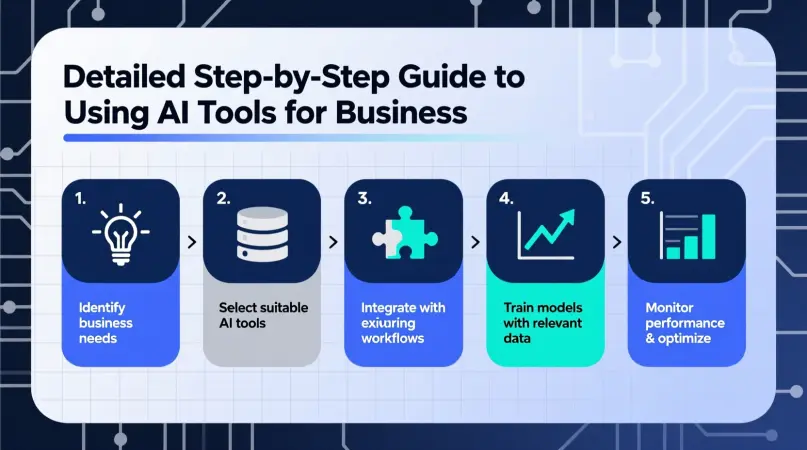
Step 1: Identify Business Needs
Before implementing any AI tool, it’s essential to identify your business needs. Ask yourself:
- Which tasks are repetitive or time-consuming?
- Where do we need better insights for decision-making?
- How can we improve customer interactions?
Clearly defining your goals will help you choose the right AI tools.
Step 2: Choose the Right AI Tool
Not all AI tools are created equal. Some are best for automation, while others excel in analytics or customer engagement. Consider:
- Automation software: For routine tasks like data entry, invoice processing, or scheduling.
- Analytics platforms: For forecasting trends, market research, and performance tracking.
- Customer engagement tools: Chatbots, recommendation engines, and CRM integrations.
Step 3: Integrate with Existing Systems
Successful AI adoption requires seamless integration with your current software. Most AI tools offer plug-ins or APIs for easy connectivity with platforms like CRM systems, ERP software, and marketing tools.
Step 4: Train Your Team
Even the best AI tools require human guidance. Train your staff to use AI effectively by providing tutorials, workshops, and documentation. Understanding how AI makes decisions will help employees leverage it confidently.
Step 5: Monitor and Optimize
After implementation, continuously monitor the AI tool’s performance. Track KPIs, user feedback, and ROI to ensure the system meets your business goals. Adjust settings, update algorithms, or switch tools if needed.
Step 6: Expand Gradually
Start small with one department or process, then gradually scale AI usage across your organization. This reduces risk and allows your team to adapt to the technology.
Benefits of AI Tools for Business
Implementing AI tools in business can deliver multiple advantages:
- Time Savings: Automate repetitive tasks to focus on strategic initiatives.
- Improved Accuracy: Reduce human errors in data entry, analysis, and reporting.
- Better Insights: Analyze large datasets to make data-driven decisions.
- Enhanced Customer Experience: Provide personalized services and instant responses.
- Cost Efficiency: Reduce operational costs through automation and optimized workflows.
- Competitive Advantage: Stay ahead of competitors by leveraging advanced technology.
- Scalability: Easily scale operations without proportional increases in resources.
Disadvantages / Risks
While AI tools offer numerous benefits, they also come with potential risks:
- High Initial Costs: Some AI tools require significant investment upfront.
- Complex Implementation: Integration with existing systems can be challenging.
- Dependence on Data Quality: AI effectiveness depends on accurate and clean data.
- Job Displacement Concerns: Automation may replace certain roles, requiring workforce adaptation.
- Security Risks: Storing sensitive data in AI systems can be a target for cyberattacks.
- Bias in AI Decisions: Poorly trained AI models can produce biased or unfair results.
Common Mistakes to Avoid
To maximize the benefits of AI tools, avoid these common pitfalls:
- Skipping Needs Assessment: Implementing AI without a clear goal leads to wasted resources.
- Ignoring Data Quality: AI decisions are only as good as the data fed into them.
- Overcomplicating Systems: Choose tools that are simple to use and integrate.
- Neglecting Training: Employees must understand AI to use it effectively.
- Expecting Immediate Results: AI requires time to learn and optimize processes.
- Underestimating Costs: Include hidden expenses like maintenance, upgrades, and training.
You May Also Like It
How to Use AI Tools: A Complete Beginner’s Guide
Tech Tutorials for Beginners: A Complete Guide to Getting Started
Latest Tech News Today: Trends, Updates, and Insights
FAQs
What types of AI tools are best for small businesses?
Small businesses benefit most from automation tools, analytics software, and customer engagement platforms that are affordable and easy to integrate.
Can AI tools replace human employees?
AI tools can automate repetitive tasks but cannot fully replace human creativity, judgment, and strategic decision-making.
How much does it cost to implement AI tools?
Costs vary widely depending on the tool, features, and scale. Cloud-based AI tools can start as low as $20–$50 per month, while enterprise solutions can reach thousands.
Do AI tools require technical expertise?
Basic AI tools are user-friendly and require minimal technical knowledge. Advanced tools may need IT support or specialized training.
Are AI tools secure for business data?
Most reputable AI tools follow strict security protocols, but businesses must implement additional measures like encryption and access controls.
How long does it take to see results from AI tools?
Results depend on the type of tool and implementation. Some improvements, like automation, are immediate, while predictive analytics may take weeks to show meaningful insights.
Can AI tools improve customer satisfaction?
Yes, AI-powered chatbots, personalized marketing, and recommendation engines enhance customer experiences and engagement.
Are AI tools suitable for all industries?
Most industries can benefit, including retail, healthcare, finance, marketing, and logistics. The key is choosing the right tool for your business needs.
Expert Tips & Bonus Points
- Start Small: Begin with one process or department before scaling AI across your organization.
- Focus on ROI: Track key performance indicators to measure the impact of AI tools.
- Keep Data Clean: Regularly update and validate data to improve AI performance.
- Combine Tools: Use multiple AI tools together for more powerful results, like analytics and automation combined.
- Stay Updated: AI technology evolves rapidly; stay informed about new tools and features.
- Test and Iterate: Continuously test AI models, refine workflows, and optimize processes for better results.
Conclusion
Adopting AI tools for business is no longer just an option—it’s a strategic move that can transform operations, improve decision-making, and enhance customer experiences. From small startups to large corporations, AI tools help automate routine tasks, analyze data efficiently, and provide actionable insights. While there are risks, careful planning, proper training, and continuous monitoring can minimize potential drawbacks.
For beginners and intermediate users, understanding AI tools may seem daunting, but breaking it down into simple steps makes adoption manageable. Start by identifying your business needs, choose the right tools, train your team, and scale gradually. The key is to focus on efficiency, accuracy, and customer satisfaction.
In the long run, AI tools can drive growth, reduce costs, and give your business a competitive edge. By implementing these technologies thoughtfully, you ensure that your business is prepared for the future and positioned for success in a data-driven world. Embracing AI is not just a trend—it’s the pathway to smarter, faster, and more effective business operations.
You May Also Like It
Tech Innovations 2025: A Complete Beginner-Friendly Guide
Wearable Technology Trends: A Complete Guide to the Future of Smart Wearables
Upcoming Smartphones 2025: Features, Trends, and Buying Guide
